On this page
Customer onboarding begins with a question: can an institution establish who it is dealing with, using reliable information and appropriate controls? For individuals, the answer may involve identity documents and supporting evidence. For businesses, it can involve company registration, representatives, shareholders and beneficial owners. In both cases, the information is often scattered across files, forms and systems.
The operational challenge is not simply to read those documents. Teams must connect the information, identify what is missing, reconcile inconsistencies and move each case through the correct process. AI-powered document verification can reduce that repetitive work. It does not, by itself, replace identity authentication, customer due diligence or a bank’s compliance decisions.
What KYC and KYB document verification actually involves
Know Your Customer (KYC) refers to processes for understanding and assessing individual customers. Know Your Business (KYB) applies related due diligence to legal entities, their representatives and ownership structures. Document verification is one component of those broader processes: it checks the completeness, consistency and relevance of submitted documentary evidence.
For individual customers (KYC)
Depending on the jurisdiction, customer type and risk profile, onboarding may require identity documents, proof of address and other supporting information. Document-focused automation can classify these files, extract names and dates, identify missing fields, compare repeated details and flag expired documents. Authenticating an identity or performing screening requires additional controls and, often, external services.
For business customers (KYB)
A corporate file may include a registration certificate, articles of association, shareholder records, beneficial ownership declarations and IDs of authorized representatives. These are related records, not independent checkboxes: the legal name, registration number, signatory and ownership information may need to be reconciled across documents and authoritative sources where available.
This makes KYB particularly demanding. A company name may appear with different abbreviations, an ownership record may be outdated, or a representative may not appear in the expected document. Automation should identify these issues for appropriate handling—not assume every difference indicates fraud.
Where manual onboarding creates avoidable friction
- Repeated retyping of the same names, dates and registration numbers into multiple systems.
- Document fragmentation across scanned PDFs, forms, emails, portals and core applications.
- Sequential checks that delay a file when one document is missing or unclear.
- Inconsistent handling of routine exceptions when instructions and evidence are dispersed.
- Limited visibility into which checks were completed, by whom and on what evidence.
These issues matter because they consume specialist time that could otherwise be directed toward ambiguous cases and higher-value judgments. The opportunity is to automate routine documentary work while retaining the controls each institution needs.
How AI-powered KYC and KYB document verification works
The workflow below illustrates a possible implementation. Specific checks, data sources and automated actions depend on configuration and available integrations.
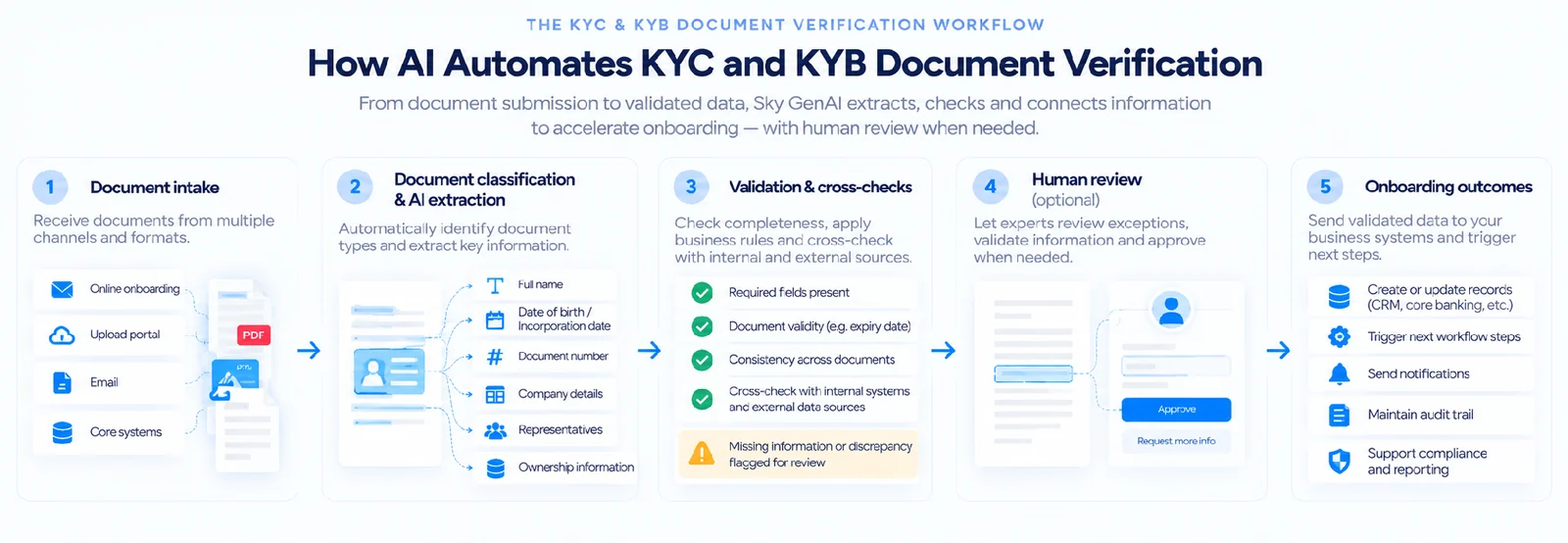
Receive and classify documents
Documents enter from onboarding portals, email, uploads or connected applications. Classification determines whether a file is an identity document, company extract, ownership record or another supporting item, so the right extraction and validation rules can be applied.
Extract and structure relevant data
OCR converts scanned text into machine-readable content; AI-assisted extraction organizes relevant fields into structured records. Examples include names, document numbers, dates, legal entity details and representative information. Extraction quality depends on document quality, language, layout and the configuration used.
Apply validation and cross-document checks
Rules can test completeness, formats, dates and consistency between submitted documents. When connected to approved internal or external sources, workflows may compare extracted details with those records as well. A detected discrepancy is a signal to investigate or clarify, not an automatic finding of fraud.
Route exceptions to human review only when needed
If the required checks pass and policy permits, a case may progress automatically. If evidence is missing, a mismatch is material, or an approval is mandated, the case can be routed to an authorized reviewer with the relevant documents and extracted data. Human review is configurable and optional in the workflow—not a compulsory stage for every file. Some decisions may nonetheless require human approval under the institution’s own rules.
Trigger downstream actions and preserve traceability
Once the applicable conditions are satisfied, the workflow can update records, request missing evidence, send notifications or route a case to the next stage. Logging checks, exceptions and actions helps make the process auditable, subject to the implementation’s recordkeeping design.
KYC vs. KYB: the same automation foundation, different questions
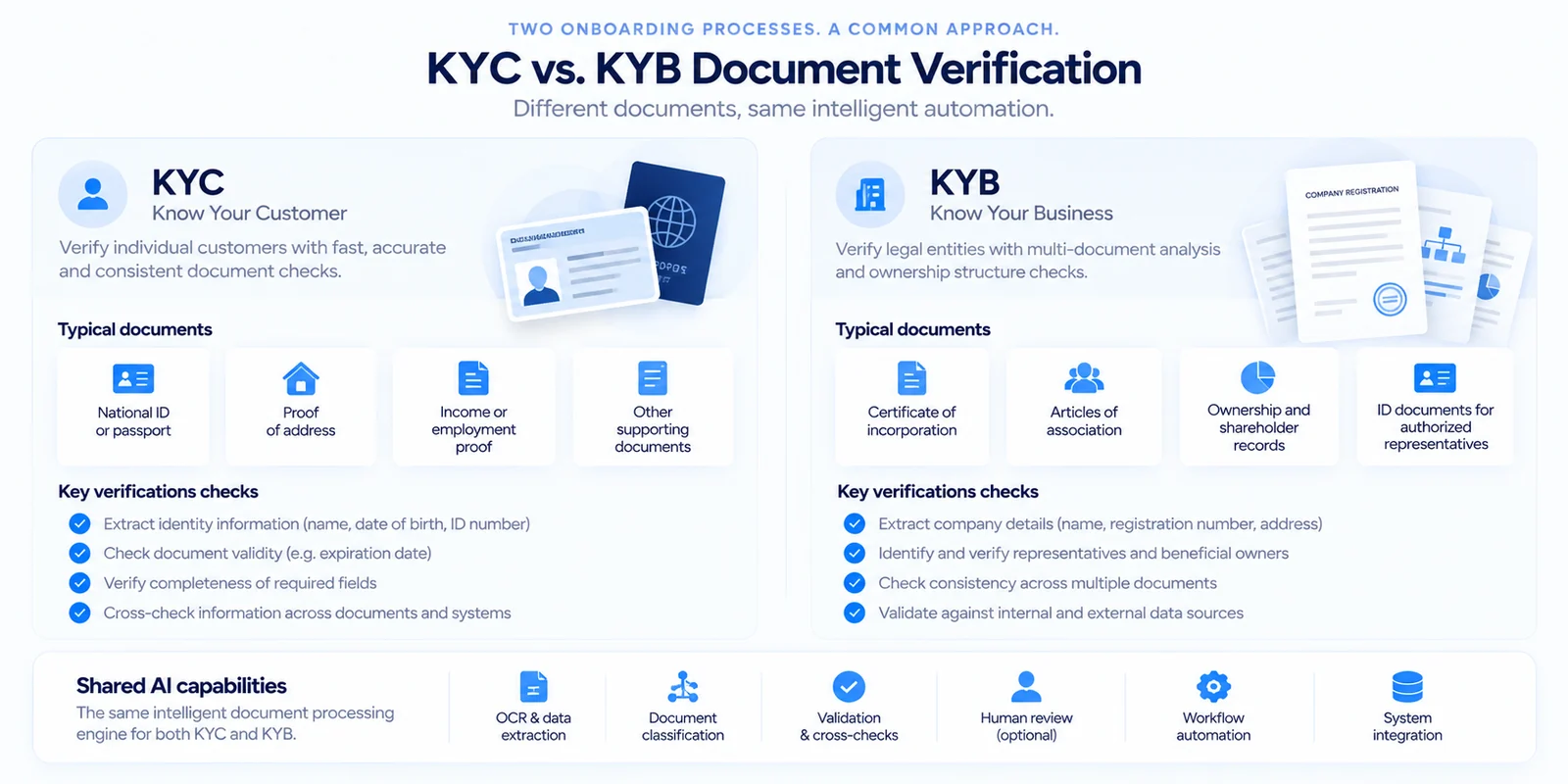
| Dimension | KYC | KYB |
|---|---|---|
| Subject | Individual | Legal entity |
| Typical evidence | Identity and supporting documents | Registration, representatives and ownership records |
| Frequent issue | Inconsistent personal details or missing evidence | Cross-document inconsistencies and connected parties |
| Automation focus | Extract, validate, route exceptions | Extract, reconcile, coordinate multi-document checks |
| Beyond document processing | Identity authentication, screening, risk assessment | Entity verification, beneficial ownership assessment, screening, risk assessment |
Importantly, OCR and document extraction cannot establish beneficial ownership on their own. They can organize evidence for the relevant due diligence process; the institution must still apply appropriate sources, policies and checks.
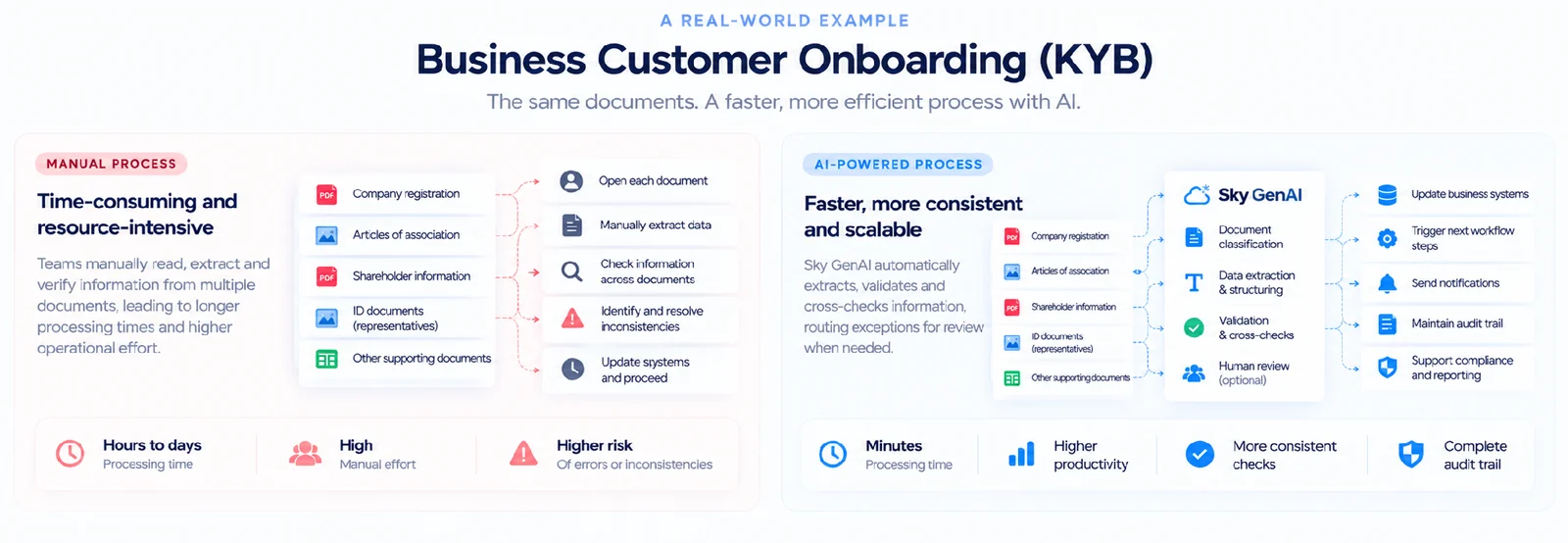
Real-world scenario: onboarding a corporate banking customer
Imagine a business applying to open a corporate account. It submits a registration extract, articles of association, representative IDs and a shareholder declaration. In a manual process, an analyst reads each file, transcribes fields, compares the registered name across documents and checks whether the stated representative and ownership information is supported.
Now imagine that the registration number matches across records, but the company name is abbreviated differently on one form. A useful system should not label the customer fraudulent. It should show the two source values, the documents they came from and the rule that detected the difference. Depending on configured tolerances and policy, the case may continue, request clarification or go to a reviewer.
With an AI-supported workflow, document types can be recognized, fields extracted, completeness checked and the next action triggered automatically where permitted. The analyst’s role shifts from repeatedly typing known information toward resolving the cases that genuinely need attention.
Benefits that institutions can measure
The business case for automation should be evaluated using observed operational indicators rather than assumed percentage gains. Useful measures include:
- Median document handling time and end-to-end onboarding time, tracked separately.
- Share of files completed without manual document re-entry.
- Exception rate and proportion of cases requiring review.
- Field-level extraction accuracy on representative document samples.
- Rate of missing-document requests and rework.
- Audit completeness and the time needed to retrieve supporting evidence.
Results will vary with document mix, data quality, rules, integrations and the institution’s governance. Faster extraction does not necessarily mean the entire compliance approval process is complete.
Where Sky GenAI fits into the onboarding architecture
Sky GenAI combines OCR, AI-assisted document understanding and workflow capabilities to support document-intensive processes. In an onboarding scenario, it can help structure submitted information, apply configured document checks, flag inconsistencies and coordinate next steps, including optional human review and connected system actions where implemented.
Its role is best understood as a document and workflow automation layer supporting the institution’s broader onboarding stack. Dedicated identity authentication, sanctions/PEP screening, authoritative registry checks and risk decisions should not be assumed to be provided by document extraction alone. The exact supported checks, integrations and deployment architecture must be confirmed for the proposed implementation.
Implementation checklist: five questions to resolve first
- Which document types, languages and formats are in scope?
- Which data fields and validation rules matter to the institution?
- Which external sources and internal systems are available for cross-checks?
- Which exceptions require human review, and who is authorized to approve them?
- How will security, access controls, traceability and performance be tested?
A phased pilot with representative files can establish a realistic baseline, reveal exception patterns and clarify where human intervention remains necessary before wider deployment.
Frequently asked questions
Can AI fully automate KYC verification?
AI can automate many document tasks, but complete KYC includes risk-based due diligence and other controls. Whether a case can progress without human intervention depends on institutional policy, regulation, data sources and system capabilities.
What is the difference between KYC and KYB automation?
KYC commonly focuses on individuals and their supporting documents; KYB covers legal entities, representatives and ownership evidence. KYB often requires more cross-document reconciliation.
Is OCR enough for KYC document verification?
No. OCR captures text. Useful document verification also requires field interpretation, validation, comparison, exception handling and integration with wider controls.
Does AI eliminate human review?
No. Human review can be optional for routine cases but triggered by exceptions, risk policies or mandatory approvals.
Can document AI detect fraud?
It can highlight some anomalies and inconsistencies, but it cannot by itself establish authenticity or detect every fraud pattern. Specialized verification and investigation may still be needed.
How can a bank evaluate automation performance?
Track document processing time, field accuracy, exception rates, rework, straight-through processing and audit evidence on a representative sample.
From document checks to a connected onboarding workflow
KYC and KYB automation delivers the most value when extracted information can move reliably into the next operational step. By combining document understanding, rule-based validation, exception handling and workflow integration, institutions can reduce repetitive work without treating automation as a substitute for due diligence.
See how Sky GenAI can support your document-intensive onboarding process